
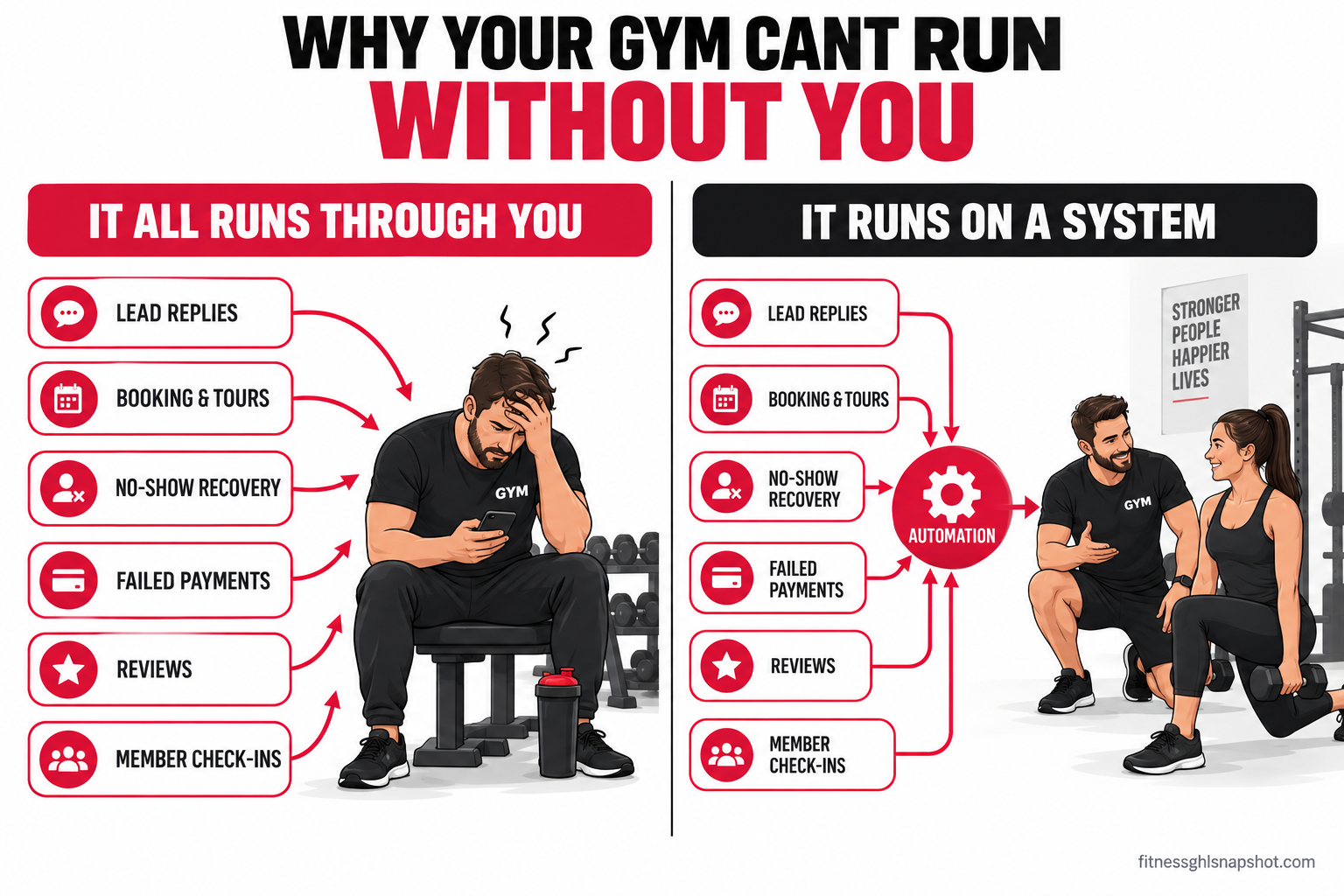
Here is the short version: if your gym falls apart the moment you take a day off, it is not because you hired the wrong people or picked the wrong software. It is because six everyday jobs, replying to leads, booking trials and tours, chasing no-shows, recovering failed payments, asking for reviews, and checking in on members, all run through you personally. You are the integration between every tool you own. Take yourself out for a weekend and the leads go cold, the no-shows pile up, and the failed cards never get a second attempt. The fix is not working harder or hiring another front-desk body. It is moving each of those six jobs onto a system that does them on time, every time, whether you are on the floor, asleep, or on a beach. Build it once and the gym runs without you standing over it.
It is 6:45am on the one Saturday you promised your family you would not look at your phone. You last. For about an hour. Then you sneak a look, and there it is: three Instagram DMs from last night asking about memberships, a missed call from a mom who wanted to book her kid’s trial, and a text from your card processor that two memberships failed to charge this morning. None of it will handle itself. So you reply from the car, you book the kid between sips of coffee, and the failed cards wait until Monday because you forgot by lunch. You did not take a day off. You took your office with you.
Every gym owner I talk to describes some version of this. The business is doing fine on paper, the floor looks busy, but the owner is the glue holding it all together, and the glue is exhausted. The scary part is not the stress. It is what the dependency costs you in money and in options: leads lost because nobody answered fast enough, revenue leaking from cards that quietly failed, and a business you could never sell or step back from because it does not actually run, you do. This post breaks the trap down into its six real parts and shows you how to take yourself out of each one, with the exact messages and triggers to steal.
Table of contents
- Why your gym can’t run without you
- The six jobs that secretly run through you
- Chokepoint 1: Replying to new leads
- Chokepoint 2: Booking trials and tours
- Chokepoint 3: Chasing no-shows
- Chokepoint 4: Recovering failed payments
- Chokepoint 5: Asking for reviews
- Chokepoint 6: Checking in on members
- The same fix at three sizes
- Keep it legal: automated texting and email
- Objections operators raise
- The bottom line
- FAQ
Why your gym can’t run without you
Start with an honest test. Picture yourself gone for a week, phone off, nobody covering your exact role. What breaks? For most independent gyms the answer is not the classes, a coach can run those, and not the cleaning or the open-and-close, a staffer has keys. What breaks is everything that lives in your head and your phone: the lead who messaged at 9pm, the tour that needed rescheduling, the member whose payment bounced, the regular who has not shown up in two weeks. Those jobs do not have a home. They have you.
That is the real definition of owner-dependency. It is not that you work hard, every owner works hard. It is that the time-sensitive, revenue-critical tasks have no system behind them, so they default to you, and they only happen when you happen to be available and remember. The business runs on your attention, and attention is the one thing you cannot scale, delegate cleanly, or get back once a day is gone.
The cost shows up in three places. First, money you never see: a lead who went cold because you were coaching when they messaged is a membership you paid to acquire and then lost for free. Second, time: the nights and weekends you spend doing $15-an-hour admin instead of the owner work that actually grows the place. Third, and the one nobody talks about until they want out, optionality. A gym that cannot run without you is a gym you cannot sell, cannot franchise, and cannot step back from when you burn out or life changes. You built an asset and accidentally turned it into a cage.
The six jobs that secretly run through you
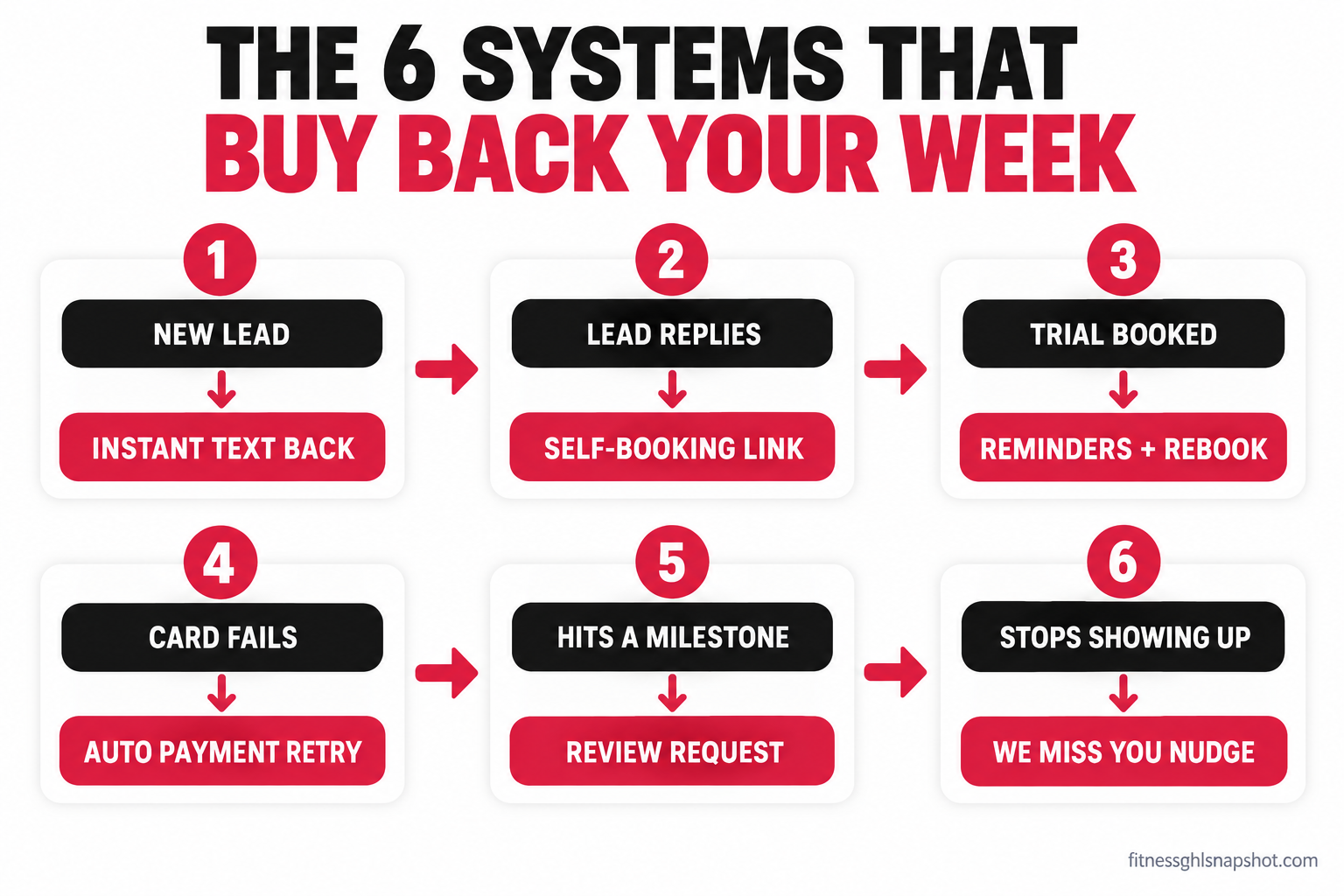
Owner-dependency feels like one giant blob of “everything,” which is exactly why it feels unfixable. Break it apart and it turns into six specific, repeatable jobs, each of which can be handed to a system. They share a pattern: they are triggered by something a customer does (or fails to do), they are time-sensitive, and they are boring enough that a human eventually forgets or deprioritizes them. That combination, important plus repetitive plus time-bound, is the exact definition of work a machine should do and a human should not.
Here is the whole map. For each job, the question is the same: what is the trigger, what is the right response, and how fast does it need to happen? Once you can answer those three things, you can build the system, and the job stops living in your head.
The chart below is an illustrative breakdown of where a typical owner’s admin hours disappear across these six jobs in a week. The exact split varies by gym, but the shape is familiar to anyone who has ever added it up: it is not one big thing eating your time, it is six medium things that never end.
Illustrative weekly hours an owner-operator spends on each of the six jobs when none of them are automated. Figures are an illustrative operator estimate, not survey data; the point is the total, not any single bar. Source: breakdown prescribed in this guide.
Work through them one at a time. For each, you get the fix, how it breaks when you set it up lazily, and the exact message to steal.
Chokepoint 1: Replying to new leads
This is the most expensive one, because leads rot fastest. A new inquiry is at peak interest the second they hit send, and that interest falls off a cliff within minutes. When you are the only person who can reply, every lead that lands while you are coaching, sleeping, or at your kid’s game sits untouched, cooling, often until the next morning. By then they have messaged two other gyms and started with whoever answered first.
The fix. Automate the first touch so it does not depend on you being free. The instant a form is filled, a DM lands, or a call is missed, a text fires back within seconds. Not an email, a text, because a text gets read now. The goal of that first message is one reply, so you ask one easy question. Then the conversation is live and a human (you, later, or a staffer) can take it from there.
Hey [First name], it’s [Gym name], thanks for reaching out! Want me to grab you a free intro this week? Reply with a day that works and I’ll lock it in. 💪
How it breaks. The classic failure is the text that silently never arrives because your number is not registered for business texting (A2P 10DLC, covered below), so carriers filter it. The second is automating the send but having nobody watch the replies, so when the lead answers “tonight works” it sits for three hours and the moment dies anyway. Automate the open, but route the replies to whoever is on. We go deep on this in speed to lead for gyms and the full cadence in the gym lead follow-up sequence; the point here is simply that the first reply must not wait for you.
Chokepoint 2: Booking trials and tours
Even when you reply fast, the next step usually still routes through you: the back-and-forth of “what times work for you,” “let me check the schedule,” “how about Tuesday.” That is three or four messages and a mental juggle of your calendar, per lead, and it only happens when you are at the desk with the schedule in front of you. Miss the window and an eager prospect loses momentum.
The fix. Hand the lead a self-booking link that shows only your real availability and writes straight into your calendar. No ping-pong, no double-booking, no “let me get back to you.” The lead picks a slot at 11pm if that is when they are deciding, and it is booked before you wake up.
Awesome, [First name]! Here’s my live calendar, grab whatever intro slot works for you and it’s locked in instantly: [booking link]. See you soon!
How it breaks. The usual mistakes are a calendar that offers slots you cannot actually staff, so you end up canceling and looking disorganized, and a booking link with no buffer, so someone books a tour during your busiest class. Set real availability rules once, with buffers and caps, and the self-booking tool protects your time instead of exposing it. For studios running classes, the same logic extends to automating class waitlists so empty spots fill themselves.
Chokepoint 3: Chasing no-shows
A booked trial that no-shows is the same lost lead with extra steps, and the reminder that would have saved it is pure admin that always falls to you. Nobody enjoys texting “hey, you coming?” the morning of, so it gets skipped, and the quiet no-show walks away for good because following up afterward feels awkward and never gets done.
The fix. A booking should automatically trigger a small reminder sequence: a confirmation right away, a nudge the day before, and a short message a couple of hours out, every one with a path to reschedule. Then, if they still miss, an automatic same-day “sorry we missed you, want to grab another time?” that turns a dead no-show into a rebook without you lifting a finger.
Day before: Looking forward to seeing you tomorrow at [time], [First name]! We’re at [address]. Text me if anything changes.
If they miss: Sorry we missed you today, [First name]! Life happens. Want me to hold you another spot this week? Here’s the calendar: [booking link]
How it breaks. The big one is reminders with no reschedule path, so a prospect whose plan changed just ghosts instead of moving the time. Always include “text me if anything changes.” The other failure is giving up after the no-show, when a single same-day rebook message recovers a real share of them. The complete version, including win-backs for repeat missers, is in how to reduce gym no-shows.
Chokepoint 4: Recovering failed payments
This is the silent one, and it is almost always pure profit left on the floor. Cards expire, get replaced, or just bounce on the billing date, and unless someone notices and chases it, that member trains for free until they quit or you catch it weeks later. When “someone” is you, scanning a billing report you open once a month if you remember, the leak runs for weeks.
The fix. A dunning sequence: the moment a payment fails, an automatic, friendly text and email go out asking the member to update their card, with a direct link to do it. If the first attempt does not land, it retries on a schedule over the next several days, escalating gently, before anything ever reaches “we have to pause your membership.” Most recovered payments come from the member simply not knowing the card failed, so a polite heads-up fixes it.
Hi [First name]! Quick heads up, your membership payment didn’t go through this month, probably just an expired or replaced card. Can you update it here so you don’t lose access? Takes 30 seconds: [update link]. Thanks!
How it breaks. The failure is tone and timing. Lead with “we’re pausing your account” and you turn a card glitch into a cancellation; lead with a helpful “your card probably just expired” and most people fix it in a minute. The other failure is a single attempt, because the first text often gets missed. Retry on a schedule. The full playbook, including how much a mid-size gym leaks to failed cards, is in failed-payment recovery for gyms.
Chokepoint 5: Asking for reviews
Google reviews are the single biggest lever on whether a local searcher picks your gym, and getting them is a job that lives entirely in your memory. You mean to ask the happy member, you forget, and your review count crawls while the gym across town that automated it pulls ahead. Asking at the wrong moment, or asking everyone including the grumpy ones, makes it worse.
The fix. Trigger a review request automatically at a happy moment, after a member hits a milestone, finishes their first month, or renews, when goodwill is highest. Route it smartly: ask how things are going first, send the happy ones straight to your Google review link, and quietly route the unhappy ones to you privately so you can fix the problem before it becomes a one-star in public.
Hey [First name], you just hit [milestone] with us, that’s awesome! 🎉 Quick favor: if you’ve got 20 seconds, a Google review really helps other locals find us. Here’s the link: [review link]. Thank you for being part of the crew!
How it breaks. The failure is blasting everyone at a random time and sending unhappy members straight to a public review form. Tie the ask to a genuine high point and gate it so complaints come to you first. The deeper version, including replying to reviews automatically, is in Google reviews for gyms.
Chokepoint 6: Checking in on members
The last one is the quiet revenue killer: members who slowly stop showing up, then cancel months later. Nobody formally quits on week one of drifting away, they just come less, then not at all. Catching that early is the highest-return retention work there is, and it is impossible to do by memory across a few hundred members. So it does not happen, and you find out they are gone when the cancellation hits.
The fix. Let the system watch attendance and flag the drift for you. When a member who used to come three times a week has not checked in for ten or fourteen days, that triggers a warm, human-sounding “we miss you” text, not a guilt trip, just a nudge that reminds them they belong. You are not watching a dashboard, the dashboard is watching for you and tapping you (or firing the message directly) when someone needs a touch.
Hey [First name], haven’t seen you in a couple of weeks and wanted to check in, everything good? No pressure at all. If life got busy, totally normal, want me to help you find a class time that fits better right now?
How it breaks. The failure is making it feel automated and accusatory (“Our records show you have not attended…”). Keep it warm and human, and make it a question, not a scolding. The other failure is having the flag with no follow-through; a flag that nobody acts on is just a sadder report. The full system is in how to stop silent churn, and the onboarding version that prevents the drift in the first place is the gym member onboarding sequence.
The same fix at three sizes
The six jobs are identical whether you train 30 clients or run 400 members. What changes is how much you automate versus delegate, and where your freed-up time should go.
Solo trainer or small PT team (20 to 100 clients). You are the entire operation, so automation is not a luxury, it is the only way any of this happens while you are mid-session. Start with the two that bleed fastest when you are unavailable: the instant lead text-back and the failed-payment recovery. Those two alone stop the biggest leaks and cost you nothing in staff. Add self-booking so you stop playing calendar tennis. Keep the member check-ins semi-manual at first, since at your size the personal touch is your edge, let the system flag the drift and you send the text yourself.
Boutique studio (80 to 250 members, a couple of instructors). Now the volume is past what memory can hold, and leads slip because nobody was sure whose job it was. Automate lead text-back, booking, no-show reminders, and payment recovery fully, and route live replies to whoever is working the desk that shift. The review engine starts paying off here because you have enough happy members to build a real Google presence. Your edge over the big franchise down the road is still that a real person answers fast, so protect the speed and let the system carry the repetitive load.
Multi-staff gym (150 to 500 members, 3 to 10 staff). Here the risk is not that jobs do not get done, it is that they fall between people, or two staff do the same one. Automate all six and assign every lead and every at-risk member an owner the moment the system flags them. This is where a real CRM earns its keep: it fires the cadence, logs every touch, and tells you which lead sources and which coaches actually retain members. Your job shifts from doing the admin to reading the numbers and coaching the team, which is finally the job you hired yourself for. The overview of which automations to add first is in 7 gym automations that pay for themselves.
Keep it legal: automated texting and email
Five of the six systems send automated texts or emails, and both are governed by law in the US. None of this is legal advice, check your own setup, but here is what these systems touch.
First, texting consent. Under the Telephone Consumer Protection Act, texting someone who just contacted you and handed over their number is on far safer ground than a cold blast, but you still need clear consent to contact them, a separation between marketing and transactional messages, an opt-out on marketing texts, and instant honoring of STOP. The FCC lays out the framework in its text-messaging rules, and TCPA statutory damages run $500 to $1,500 per message, so this is not a corner to cut.
Second, A2P 10DLC. US carriers require any business sending application-to-person texts over a standard 10-digit number to register its brand and campaigns through The Campaign Registry, and unregistered traffic gets filtered or blocked. If your automated text-back silently is not arriving, this is almost always why. Register before you scale, not after you lose a month of leads to a filter.
Third, email. Your payment-recovery and review emails fall under CAN-SPAM, which the FTC summarizes in its compliance guide: an accurate sender and subject line, a physical mailing address, and a working unsubscribe you honor, even on friendly messages.
Fourth, a myth worth clearing, because it spooks operators building cancellation flows. There is no federal “click-to-cancel” rule in force in 2026. The FTC’s version was vacated by the Eighth Circuit on July 8, 2025, and nothing has replaced it. State auto-renewal laws and the FTC Act still apply, so keep cancellation genuinely easy regardless, which we cover in gym membership cancellation and auto-renewal law in 2026.
Objections operators raise
“Won’t automated messages make my gym feel impersonal?” Only if you automate the wrong things or write them like a robot. The whole point is to automate the triggers and the timing, the stuff a machine does better, so you have more time for the human part, the conversation, the tour, the real check-in. A member does not care whether the “your card failed” heads-up was triggered automatically; they care that it was friendly and saved them from losing access. Write the messages the way you talk and they read as attentive, not cold. The impersonal version is the current one, where the member hears nothing for weeks because you were busy.
“Can’t I just hire a front-desk person to do all this?” You can, and for the live, human parts you probably should. But a person is the wrong tool for the repetitive, time-sensitive triggers. A hire still goes home at night, takes days off, and forgets, which means leads still rot at 9pm and failed cards still wait for the weekend. Automation does not call in sick. The best setup is both: the system handles the instant, always-on triggers, and your staff handle the conversations the system starts. You are not replacing people, you are freeing them from the robotic part of the job.
“I already pay for gym software. Doesn’t it do this?” Partly. Platforms like PushPress, Gymdesk, and TeamUp send a basic appointment reminder and a welcome email. What many do not do on their own is run the whole lead cadence, retry failed payments with escalating messages, route reviews intelligently, and watch attendance to flag silent churn. A common setup is to keep the software that runs your schedule and billing and add a dedicated automation layer on top that connects to it. We cover connecting the two in connect your gym software to GoHighLevel.
“This sounds like a huge project. I don’t have time to build it.” That is the irony, the owners who most need this are the ones too buried to build it. You have two honest options. Build it yourself in whatever tool you already use, one system at a time, starting with the lead text-back, over a few weekends. Or have the whole thing installed done-for-you and wired to your forms, calendar, and billing, so the time cost is a short onboarding instead of months of tinkering. Either way the first system you turn on starts buying time back immediately, which funds the next one.
The bottom line
Go back to that Saturday morning with your phone buzzing in the car. In the gym that runs through you, that is every weekend: three DMs, a missed call, two failed cards, all waiting for you to personally handle them, forever. In the gym with the six systems running, that same Saturday looks different. The DMs got an instant text back and two of them booked themselves into Monday’s intro slots overnight. The missed call triggered a text that booked the kid’s trial. The failed cards got a friendly update link at 8am and one is already fixed. You find all this out Monday, as good news, instead of spending your weekend being the glue.
That is the whole difference between owning a gym and owning a job. You will always be the one who coaches best, closes the tour, and sets the culture, nobody automates that, and you should not want to. But the six repetitive, time-sensitive jobs that currently chain you to your phone do not need you. They need a system. Build it once, and the gym finally runs whether you are standing over it or not.
Frequently asked questions
Why can't my gym run without me?
Because the time-sensitive, revenue-critical jobs have no system behind them, so they default to you. Replying to leads, booking trials, chasing no-shows, recovering failed payments, asking for reviews, and checking in on quiet members all happen only when you are available and remember to do them. None of those jobs lives in a tool or a defined process, they live in your head and your phone, so the business can only move as fast as you can and stalls the moment you step away. The fix is to give each job a trigger and an automatic response so it runs on its own.
What should I automate first in my gym?
Start with the two jobs that leak the most money when you are unavailable: instant lead text-back and failed-payment recovery. A new lead goes cold within minutes, so an automated text that fires the second a form or DM comes in catches people a next-morning callback would lose. Failed payments quietly drain revenue for weeks when nobody notices, so an automatic update-your-card sequence recovers money you are currently losing by default. Both cost nothing in extra staff and start paying for themselves immediately, which funds the rest of the systems.
Should I hire a front-desk person or automate instead?
Do both, but for different parts. A person is the right tool for live conversations, tours, and the human check-in, and the wrong tool for repetitive, always-on triggers. A hire still goes home, takes days off, and forgets, so leads still rot at 9pm and failed cards still wait for the weekend if a person is your only system. Let automation handle the instant, 24/7 triggers (text-back, reminders, payment retries) and let your staff handle the conversations those triggers start. You free the person from the robotic work instead of paying them to do it.
Isn't automated messaging impersonal for a gym?
Not if you automate the timing and write the messages like a human. Members do not mind that a friendly heads-up about an expired card or a 'we miss you' check-in was triggered automatically, they mind being ignored for weeks, which is what happens when every message waits on a busy owner. Automating the triggers actually frees you to be more personal where it counts, in the tour, the class, and the real conversation. Write in your own voice, keep it warm, and the messages read as attentive rather than robotic.
Doesn't my existing gym software already do all this?
Usually only part of it. Most booking and billing platforms send a basic appointment reminder and a welcome email, but many do not run the full lead follow-up cadence, retry failed payments with escalating messages, route review requests intelligently, or watch attendance to flag members who are quietly drifting away. A common and effective setup is to keep the software that runs your schedule and billing and add a dedicated automation layer on top that connects to it and handles the six jobs end to end, rather than switching platforms entirely.
Is it legal to send automated texts and emails to gym members?
Yes, when done correctly. Under the TCPA, texting someone who gave you their number and consent is on much safer ground than a cold blast, but you should capture clear consent, keep marketing separate from transactional messages, include an opt-out, and honor STOP instantly. US carriers also require businesses to register their number for A2P 10DLC or texts get filtered. Automated emails fall under CAN-SPAM, so use an accurate sender and subject, include a physical address, and honor unsubscribes. TCPA damages run $500 to $1,500 per message, so consent and opt-out are not optional. This is general information, not legal advice.
How long does it take to set up these systems?
It depends on whether you build or install. Building yourself in a tool you already use, you can stand up the first system (lead text-back) in a weekend and add one more every couple of weeks, so the full set takes a month or two of part-time work. Having it installed done-for-you compresses that to a short onboarding, often around 24 hours for a prebuilt system wired to your forms, calendar, and billing. Either way, you do not have to build all six at once; each system you turn on starts buying time back right away, which makes the next one easier to tackle.
Written by Bryce Kendrick, Fitness Growth Strategist. Bryce spent eight years running the floor and front desk at a fast-growing CrossFit box before moving full-time into automation for gyms. He has watched too many good operators turn their gym into a cage, and he writes the way he coaches: direct, numbers-first, and allergic to fluff.